Stock Researcher
A cited deep-dive on any stock — filings, numbers, no fiction.
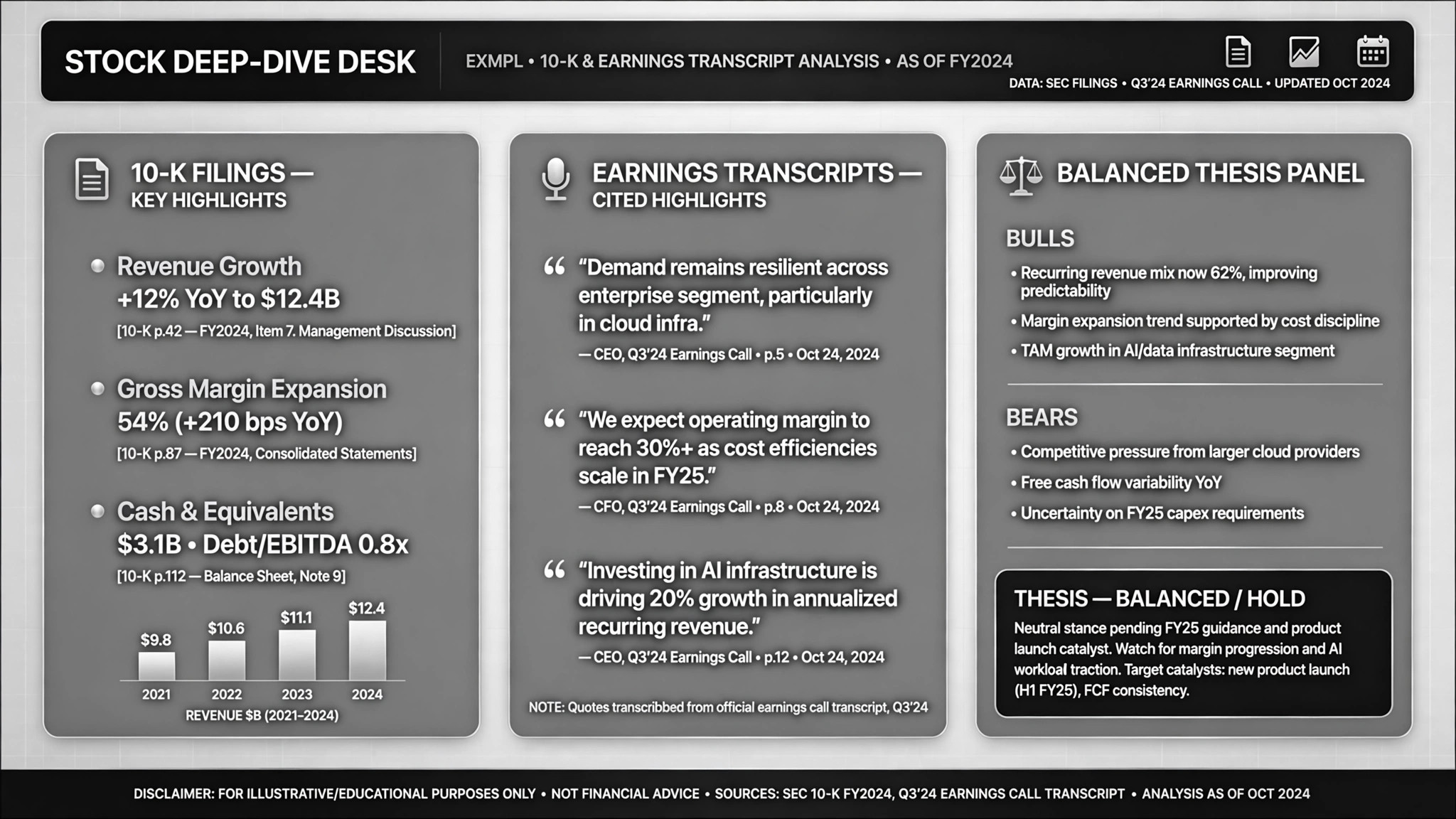
Writes a cited research note on any stock — filings, transcripts, key numbers with sources — and flags when a position breaks your risk rules. Research only: it never trades, and you make every decision.
Install it in 3 steps
No sign-up. No CLI tools. Pick your AI, copy one line, paste it over.
Prefer doing it yourself? Download the ZIP, unzip it into the directory shown above, restart your AI session — same result.
Real-world proof
Real people did this exact job with AI agents.
Research stocks by pulling filings and transcripts
Read case →Use caseDo equity research with Claude Code without coding
Read case →What’s inside
One SKILL.md (the playbook) + one starter template. A preview:
Stock Researcher
When to use
- You want a deep-dive on a stock before investing — filings, earnings transcripts, real numbers, every claim cited
- You hold a portfolio and want a recurring research briefing (e.g. twice a week) on your holdings and watchlist
- You need the strongest counter-argument: a well-sourced bear case on a stock you already like
- You set risk rules (e.g. "flag me if it drops 15%") and want breaches surfaced automatically
- You're not a coder and want research notes in plain language with references you can actually check
Workflow
Give the AI the ticker (or a list of holdings plus a watchlist), your risk rules (stop-loss levels, max position size), and the sources it should trust: company filings first, earnings transcripts, then reputable financial press. You define the risk rules; the AI never sets or changes them.
- Set scope and sources (input: ticker + holdings/watchlist + risk rules → output: research brief)
The AI fetches the latest 10-K/10-Q, recent earnings call transcripts, and relevant news. Primary filings are evidence; press coverage is context. If a document can't be retrieved, the skill says so instead of guessing from summaries.
- Pull the primary documents (input: ticker → output: source bundle)
Summarize the business, the key numbers, and what management claims — with every claim tagged to its source and page. If a number can't be sourced, it's labeled unverified or dropped. One real case had the AI run the numbers twice to catch misreads.
- Extract and cite (input: source bundle → output: cited fact list)
Deliberately argue the strongest case *against* the stock using the same cited facts. This is the skill's differentiator: a research note that tries to talk you out of the trade, not one that confirms what you already believe.
- Write the bear case (input: cited facts → output: bull/bear section)
The note is saved as markdown in your notes library. Before acting on anything, you spot-check the citations — open the cited page, confirm the number. AI misreads tables; the citation exists so you can catch it.
- Save and spot-check (input: research note → output: saved note + verification pass)
On schedule, the AI refreshes the news, bull/bear arguments, and scenario analysis for your holdings and watchlist, and flags any position that broke your risk lines. Flagged doesn't mean sell — you still make every buy/sell decision yourself.
- Run the risk watch (input: schedule + risk rules → output: briefing with flags)
Output spec
- Research note (markdown): business summary, key figures with source citations, management claims vs. evidence, bull case, bear case, open questions
- Every factual claim carries a citation (document + page, or URL); un